
How to Find Plymouth County Arrest Records
An arrest in Plymouth County usually leads to booking at a local police department and, for those held, to the Plymouth County Correctional Facility run by the Plymouth County Sheriff's Department. The county does not run a conventional name-search arrest portal, so finding arrest information takes a few steps.
Recent arrests show up fastest through the jail and the court. After arraignment, the criminal case appears on MassCourts.
- Check the Plymouth County inmate records page for current custody.
- Contact the arresting police department for a local arrest log or report.
- Search MassCourts by name for the District or Superior Court case.
- Use the docket number to read charges, bail, and the next hearing.
- Request a certified copy from the clerk if you need an official record.
Broader criminal court history lives on the Plymouth County court records page, which covers the full case file beyond the arrest.
Where Plymouth County Arrest Information Appears
Arrest data is scattered by design. Each agency keeps its own piece. The jail knows who is in custody now. The police know the arrest details. The court knows the charges once a case opens.
- Jail intake and roster, held by the Sheriff's Department.
- Police arrest logs and reports, held by the local department.
- Criminal dockets in the District and Superior Court.
- CORI criminal history, held by the state DCJIS.
Because the pieces live in different offices, no single free website shows a complete Plymouth County arrest record. Stitch the sources together for the full picture.
How soon does an arrest show up? The jail roster reflects custody quickly, often within hours of intake. The court case appears after arraignment, which is usually the next business day for someone held. Police reports can take longer and may be partly redacted. Timing varies by agency, so check more than one source if a case is fresh.
Arrest Record vs Criminal Court Record
An arrest record and a criminal court record are not the same. The arrest record is the law-enforcement event. The court record is what happens after charges are filed. The comparison below shows the difference.
| Point | Arrest Record | Criminal Court Record |
|---|---|---|
| Who creates it | Police or sheriff | The District or Superior Court |
| What it shows | Booking, charges at arrest, custody | Charges filed, pleas, verdict, sentence |
| Where to find it | Jail roster, police report | MassCourts docket and clerk |
| Means guilt? | No | Only if there is a conviction |
An arrest can happen without charges ever being filed, and charges can be filed without an arrest.
Charges vs Convictions in Plymouth County
This distinction matters more than any other on an arrest record. A charge is an accusation. A conviction is a finding of guilt after a plea or a trial. Many charges end in dismissal, a not guilty finding, or a continuance without a finding, and none of those is a conviction.
| Point | Charge | Conviction |
|---|---|---|
| Meaning | An accusation of a crime | A finding of guilt |
| Stage | At or after arrest | After a plea or trial |
| Outcome options | Dismissed, nolle prosequi, not guilty | Guilty plea or guilty verdict |
When you read a Plymouth County arrest record, look past the charge to the disposition before drawing any conclusion.
CORI: Massachusetts Criminal History
Massachusetts keeps criminal history in a system called CORI, short for Criminal Offender Record Information. CORI is run by the Department of Criminal Justice Information Services, not by the courts. A CORI report and a court docket are different products, and CORI dissemination is controlled by statute. The agency that runs CORI is shown below.
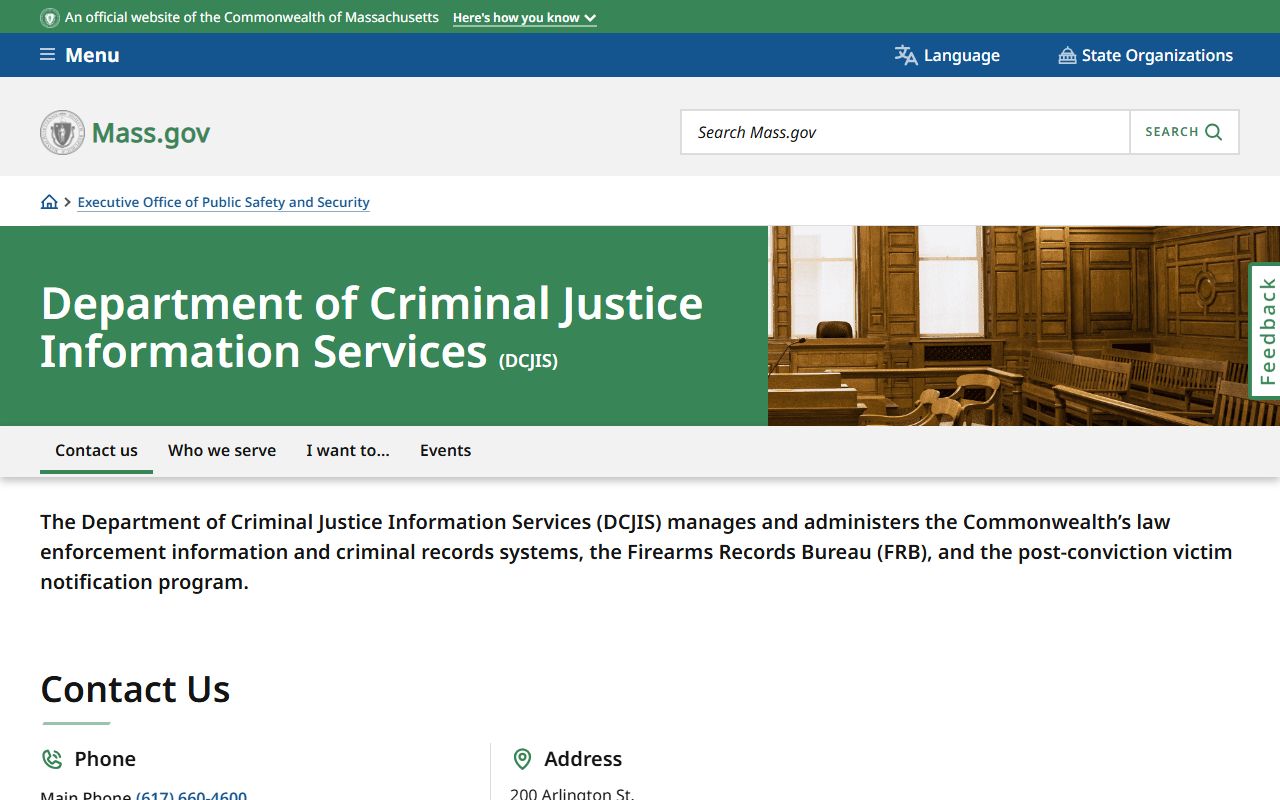
CORI terms are defined in M.G.L. c.6, §167, and who may receive a report is set by M.G.L. c.6, §172. To get your own record, use the official CORI request process rather than piecing it together from dockets.
What a Plymouth County Arrest Record Shows
The detail you see depends on the source. A jail roster is brief. A police report is fuller but may be redacted. The fields below are the ones commonly found on a public roster or booking record.
| Field | What It Shows |
|---|---|
| Name | The booked person's legal name. |
| Booking number | The intake number, where shown. |
| Booking date | When the person was taken into custody. |
| Charges | A summary of the offenses at booking. |
| Bail or bond | The amount or conditions, where listed. |
| Court | The court handling the case, where shown. |
Housing location, medical flags, and protective-custody status are not public, and a public roster often omits a photo.
Mugshots and Booking
Booking is the intake step after an arrest. It includes identification, a property inventory, fingerprints and a photograph where required, a warrant check, and a medical screening. A booking photo, often called a mugshot, may be taken, but Plymouth County public rosters frequently do not publish photos.
After booking, a person normally gets a prompt arraignment in District Court or Superior Court depending on the charge. A bail commissioner, clerk-magistrate, or judge can set bail with conditions such as no contact, stay away, or treatment.
Bail, Holds, and Custody After an Arrest
What happens after an arrest depends on the charge and the court. Some people are released on personal recognizance, a written promise to return. Others must post bail or meet conditions before release. The bail line on a docket, where public, shows the amount or the conditions set.
A person may stay in custody even after a Plymouth County case resolves. A warrant from another court, a probation detainer, a state sentence, or a federal hold can keep someone held. To track current custody, use the inmate records page and the jail's official contact. The court docket shows the legal side: charges, bail, and the next date.
Holds are common and easy to miss. A clean release on one case does not mean release from custody overall.
Juvenile Arrest Records in Plymouth County
Arrests of minors are handled very differently. Juvenile Court records, including delinquency and youthful offender matters, are restricted by Massachusetts law and do not show as ordinary public arrest records. Confidentiality is set by M.G.L. c.119, §60A.
Access to a juvenile record is generally limited to the youth, parents, counsel, and authorized agencies. The clerk will not hand a juvenile file to the general public. For the locations and access rules, see the Juvenile Court page.
Sealed vs Expunged Records
Massachusetts gives two ways to limit access to a criminal record, and they are not the same. Sealing restricts public access but keeps the record for courts and certain agencies. Expungement is narrower and removes or destroys the record under tight rules. The comparison below sets them apart.
| Point | Sealing | Expungement |
|---|---|---|
| Effect | Hides from public view | Removes or destroys the record |
| Who can still see it | Courts and some agencies | Almost no one |
| Eligibility | Broader, with waiting periods | Narrow statutory categories |
Conviction sealing follows M.G.L. c.276, §100A. Nonconviction sealing, for outcomes like dismissals and not guilty findings, follows M.G.L. c.276, §100C, shown below.
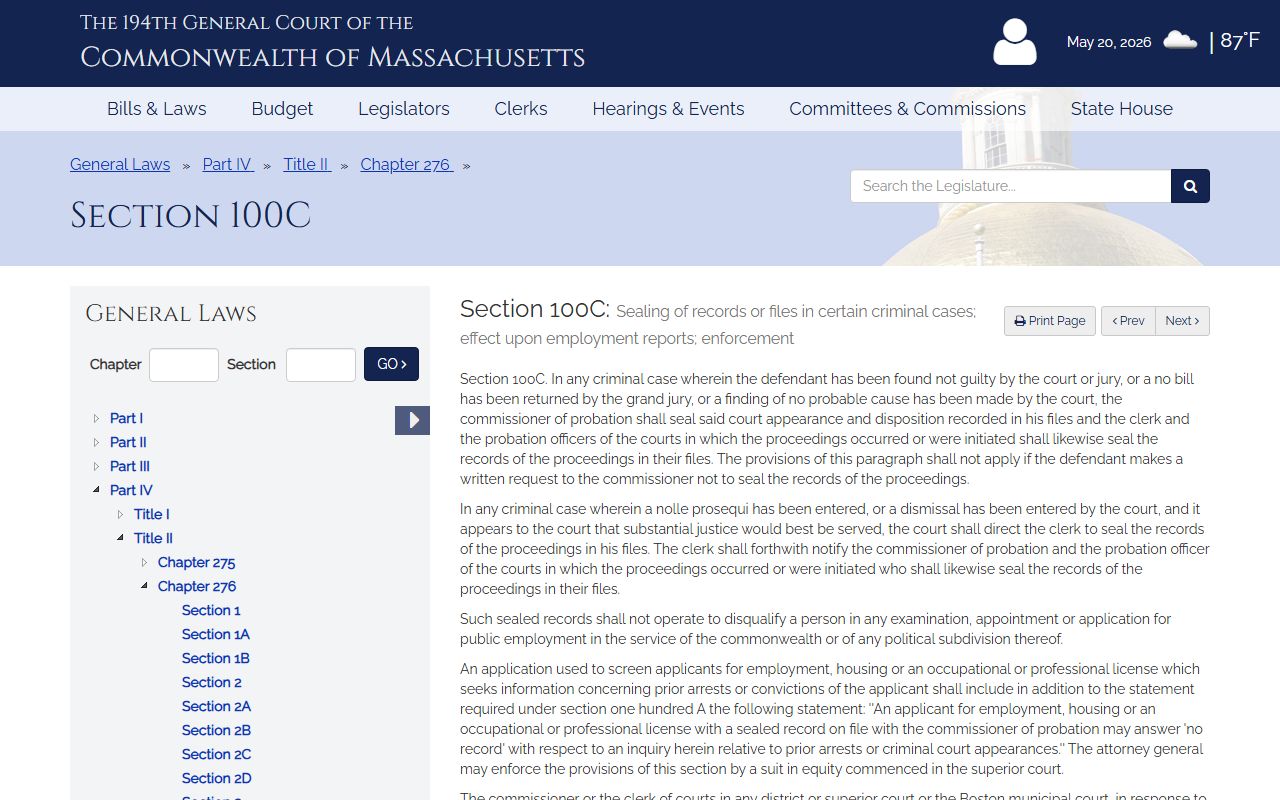
Eligibility turns on the offense, the outcome, the waiting period, and the rest of a person's record. A pending case can block a request.
Background Checks and Arrest Records
Employers, landlords, and licensing boards may run background checks, but the rules are strict. CORI access is limited by who you are and why you are asking. An arrest with no conviction often cannot be used the way a conviction can. Sealed and expunged records should not appear in a proper check.
Note: This site is not a consumer reporting agency, and its data cannot be used for employment, tenant, credit, or other FCRA-regulated screening.
Plymouth County DA and Defense Resources
The Plymouth County District Attorney prosecutes state crimes in the county, from District Court misdemeanors to Superior Court felonies, and runs victim-witness services. People facing charges who cannot afford a lawyer can ask the court for appointed counsel through the Committee for Public Counsel Services, shown below.

The court decides eligibility and then appoints CPCS staff counsel or a bar advocate. For DUI and other motor vehicle crimes, see traffic court records, and for outstanding warrants see warrant records.