
Massachusetts Land Court Overview
The Land Court is one of the seven Trial Court departments. Its judges and staff specialize in real property law, registered land, and related title questions. The court sits in Boston but takes cases from every county in Massachusetts, including Plymouth County.
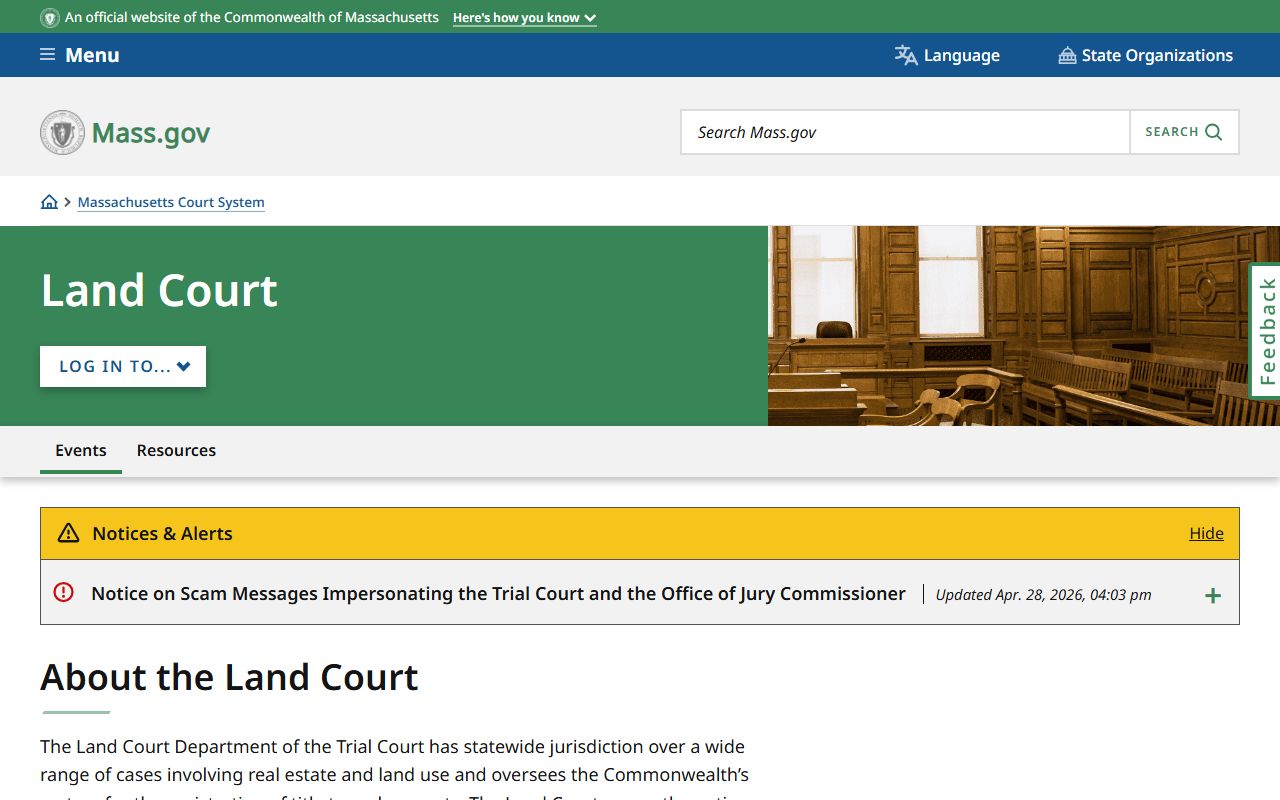
The department page explains the court's role across the state and lists its main case types.
Why the Land Court Matters in Plymouth County
Plymouth County has a deep history of land use, from cranberry bogs to coastal subdivisions to growing inland towns. Many of those parcels touch issues the Land Court was built to handle. Registered land, old title chains, partition between co-owners, and tax foreclosure all reach the Land Court at some point.
The court sits in Boston, but the property at issue can be anywhere in the state. So a Plymouth County land matter may be argued in a Boston session and recorded back to the county registry.
What the Land Court Hears
The court's case mix is narrower than the District Court, but it covers a lot of ground in real property. The list below shows the main categories.
- Registered land - cases under the Land Registration Act.
- Title disputes - actions to confirm or quiet title.
- Partition - division of property held by co-owners.
- Tax lien foreclosure - municipal foreclosure of property tax liens.
- Zoning and subdivision appeals - some land use challenges.
- Mortgage discharge and survey matters - title-related corrections.
Not every land dispute belongs in the Land Court. Some claims, like simple breach of a real estate contract, can sit in District Court or Superior Court instead.
Registered Land vs Recorded Land
Massachusetts uses two systems for land. Recorded land is the older system, where deeds are recorded with the registry of deeds. Registered land sits under the Land Registration Act and uses a separate Land Court process. Many Plymouth County properties are recorded land, but some are registered, and the rules differ.
| Point | Recorded Land | Registered Land |
|---|---|---|
| Office | Registry of Deeds | Land Court Registration District |
| Title proof | Title chain through recorded deeds | Certificate of title |
| How disputes move | Civil court, sometimes Land Court | Land Court |
A title attorney can tell you which system a Plymouth County parcel sits under.
Searching Plymouth County Land Court Cases
Public Land Court dockets show on MassCourts when the department is selected. Search by docket number, by party name, or by case type as the system allows.
- Open MassCourts and choose Land Court.
- Search by docket number or by party name.
- Filter by case type if the option appears.
- Open the case to read the entries.
- Contact the Land Court clerk for copies or restricted items.
For docket-reading help across departments, see court dockets.
Land Court vs Plymouth County Registry of Deeds
The Plymouth County Registry of Deeds is not the Land Court. The registry records deeds, mortgages, and similar instruments. The Land Court hears the lawsuits about those instruments, registered land titles, and certain property claims. After the Land Court enters a judgment, the registry records the result.
For a deed copy, the registry is the office. For a court ruling that interprets a deed or a registered title, the Land Court is the office. The two work together but do not do the same job.
Zoning Appeals and Land Court
Some zoning and subdivision appeals reach the Land Court under specific statutes. A property owner unhappy with a town board decision may have a path to Land Court review, alongside any Superior Court route. The right path depends on the statute and the kind of decision.
If a Plymouth County town board denies a permit or imposes conditions, a quick read of the appeal rights matters. Deadlines are short, and choosing the wrong forum can end the appeal before it starts.
Filing a Plymouth County Land Court Case
Filings can be made in person at the Boston session, by mail, or through approved electronic filing. The forms depend on the case type. Partition, quiet title, and tax foreclosure each use their own filings.
A property dispute usually involves counsel, since title and registered land law is technical. Self-represented parties can still file, but the rules and forms are detailed.
Tax Lien Foreclosure
Towns and cities can foreclose property tax liens through the Land Court. The process gives the owner notice and a chance to redeem the property by paying the debt and costs. If the owner does not act, the court can foreclose the right of redemption.
For Plymouth County property owners who fall behind on taxes, a Land Court notice is a serious signal. Quick action and counsel can preserve the property; ignoring the notice can lead to losing it.
The town treasurer or tax collector starts the chain by recording a tax taking. The Land Court enters the picture when the foreclosure is filed. By that point, a property owner is on a clock.
Partition Cases in the Land Court
Partition is a case to divide property held by more than one owner. Heirs who jointly own a Plymouth County parcel after a parent's death sometimes end up in partition when they cannot agree on what to do with the property. The court can order a physical division, a sale and split of the proceeds, or another resolution that fits the facts.
Partition cases can take time and may involve appraisers and commissioners. The court tries to find a result that respects each owner's share.
Land Court Copies and Fees
Copy fees at the Land Court depend on the document and the certification. Plain copies are cheaper than certified copies. The clerk can quote the current rate and the accepted payment methods.
| Item | Amount |
|---|---|
| Plain copy of a Land Court document | Set by the clerk; confirm with the court |
| Certified copy | Set by the clerk |
| Filing fee | Set by the court for the case type |
| Search fee for older records | May apply; confirm with the clerk |
Restricted Land Court Materials
Most Land Court records are public, but some materials are restricted. Financial details, certain personal data, and items the court has impounded do not appear in the public file. For broader public access framework, see public records.
Note: A Land Court case is a court record, not a registry record; a deed change is recorded at the registry after the Land Court enters judgment.