
How to Find Plymouth County Marriage and Divorce Records
Two offices, two record types. Marriage falls under vital records, handled by city and town clerks and the Registry of Vital Records and Statistics. Divorce falls under the courts, handled by the Probate and Family Court in Plymouth and Brockton.
Knowing the split tells you where to knock first. The list below sorts the main paths for each record type so you can match an office to a need.
- Marriage license and certificate: city or town clerk, or the state registry.
- Divorce filing and judgment: Probate and Family Court.
- Older or genealogical records: town clerk, registry, or state archives.
The Probate and Family Court page covers the broader family and estate work of that court.
Marriage Licenses Through City and Town Clerks
In Massachusetts, a marriage license is issued by a city or town clerk, not by the county court. A couple files a Notice of Intention of Marriage with a clerk, meets the waiting-period rules, and then has the ceremony performed by an authorized officiant. The license is valid statewide once the rules are met. Statewide vital records run through the Registry of Vital Records and Statistics, shown below.
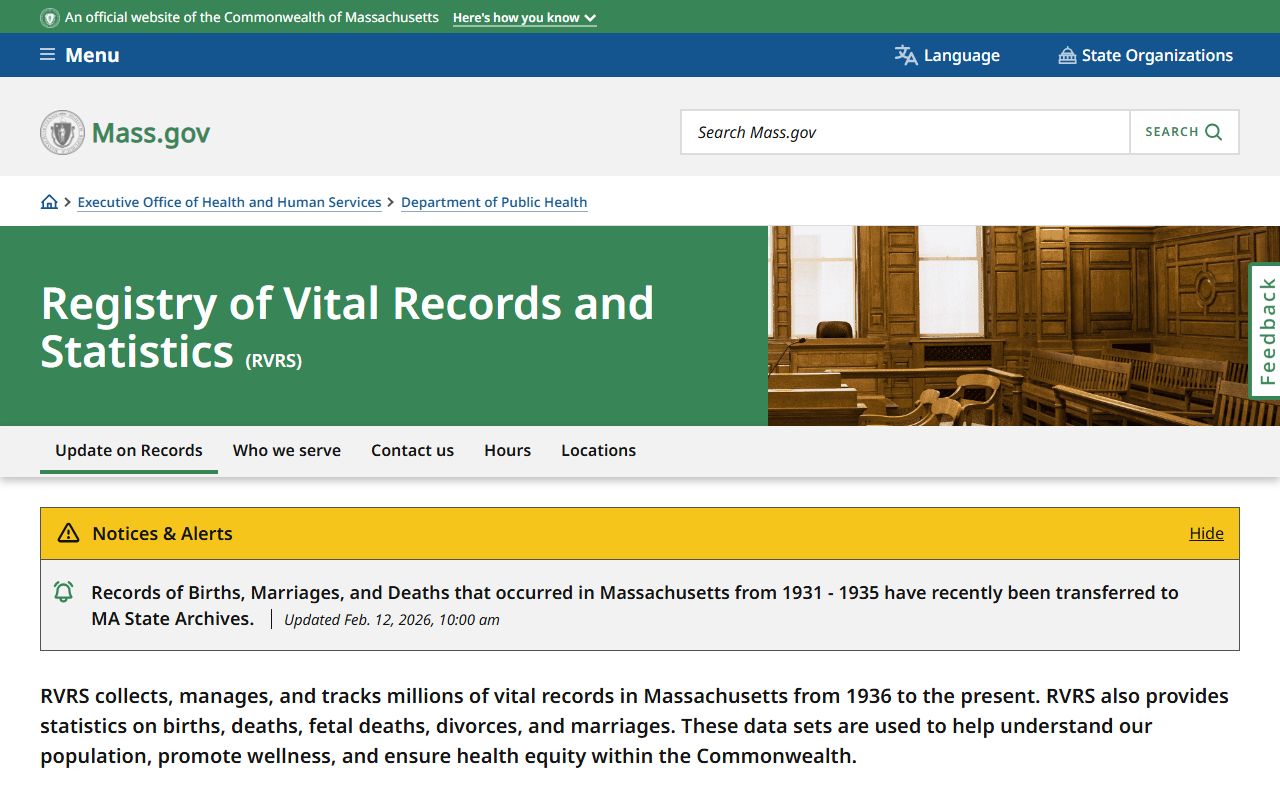
The official Registry of Vital Records and Statistics handles statewide copies, while the local clerk handles the license itself.
- Both parties follow the city or town clerk's process to file the Notice of Intention.
- Provide identification and the required personal information.
- Pay the local license fee, which varies by town.
- Observe the Massachusetts waiting period unless a court waiver applies.
- Have an authorized officiant perform the ceremony.
- The officiant returns the license for recording.
- Order certified certificate copies from the town or the registry.
Marriage License Application Fields
The Notice of Intention asks for personal details from both parties. Knowing the fields ahead of time speeds up the clerk visit. The table below lists the common fields in the application workflow.
| Field | Required | Notes / Format |
|---|---|---|
| Party A full name | Yes | Legal name. |
| Party B full name | Yes | Legal name. |
| Residence and address | Yes | Current address. |
| Date and place of birth | Yes | Used for the vital record. |
| Parent information | Yes | Names and birth surnames if required. |
| Prior marriage or civil union | Yes | Dissolution date may be required. |
| Signatures and oath | Yes | Parties sign under penalties of perjury. |
Marriage Certificate Copies
A marriage certificate is a vital record, not a court record. You order copies from the city or town where the license was issued, or from the state registry. The official ordering page is shown below.
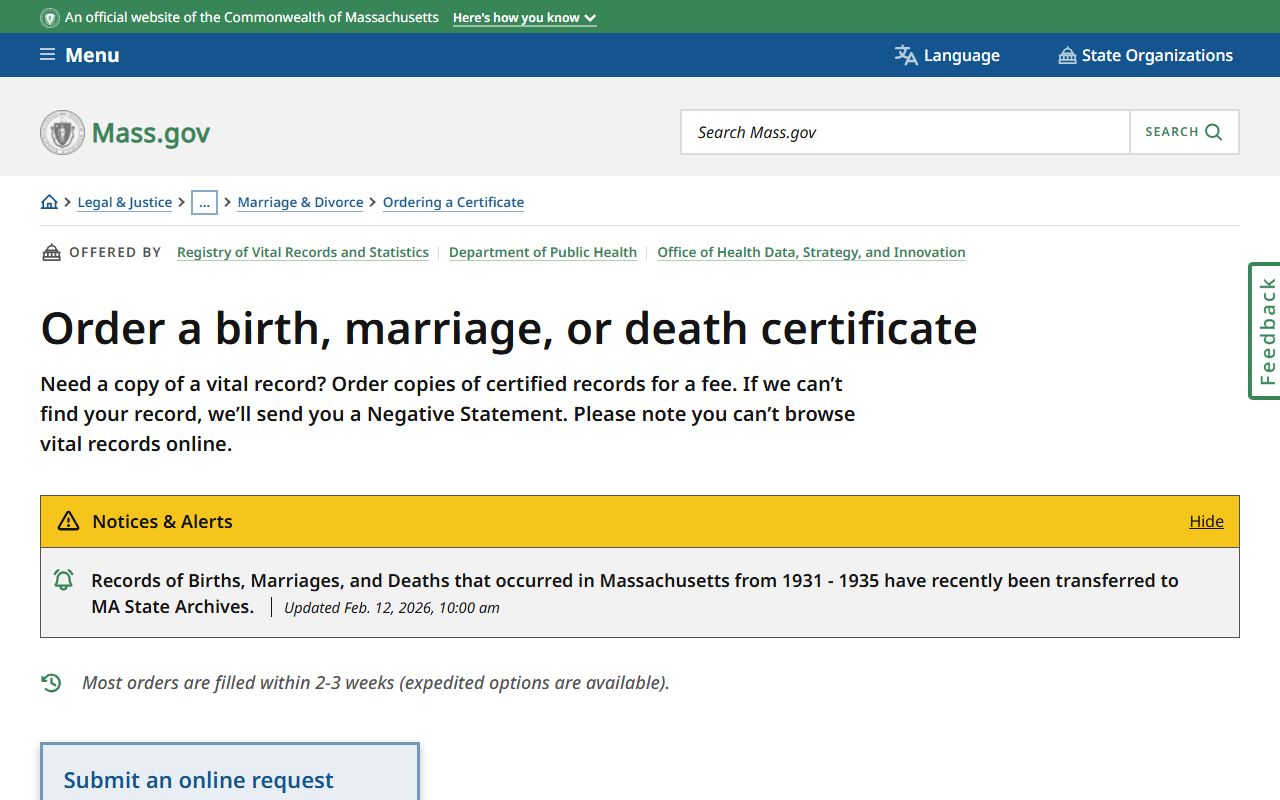
Use the official guide to order a birth, marriage, or death certificate. A certified copy is the version most agencies accept for legal purposes.
Divorce in the Probate and Family Court
Divorce in Plymouth County is handled by the Probate and Family Court, not the District Court. The court hears divorce, custody, support, modification, and contempt matters. A divorce file can include the complaint or joint petition, a separation agreement, financial statements, a parenting plan, temporary orders, and the judgment of divorce nisi that becomes final after a set period.
Some documents are restricted. Financial statements and child-related materials may be impounded, so they are not always open to the public even when the case is.
Filing for Divorce in Plymouth County
The path depends on whether the divorce is joint and uncontested or contested. Either way, residency and eligibility come first. The official guides on how to file for divorce and on divorce eligibility explain the requirements.
- Confirm Massachusetts residency and eligibility.
- Decide whether the case is joint or contested.
- Prepare the complaint or joint petition, the marriage certificate, and financial statements.
- Add parenting and support forms if children are involved.
- File at the proper Probate and Family Court for Plymouth County.
- Serve the other party if the case is not joint.
- Attend the case management, pretrial, or final hearing.
People who cannot afford the fee can ask the court for a fee waiver using an affidavit of indigency. The court reviews the affidavit and decides whether to waive or reduce the cost.
Divorce Record Copies
Divorce records are requested from the Probate and Family Court where the case was heard, in Plymouth or Brockton. The official guide explains how to get a copy of a divorce record. That guide is shown below.
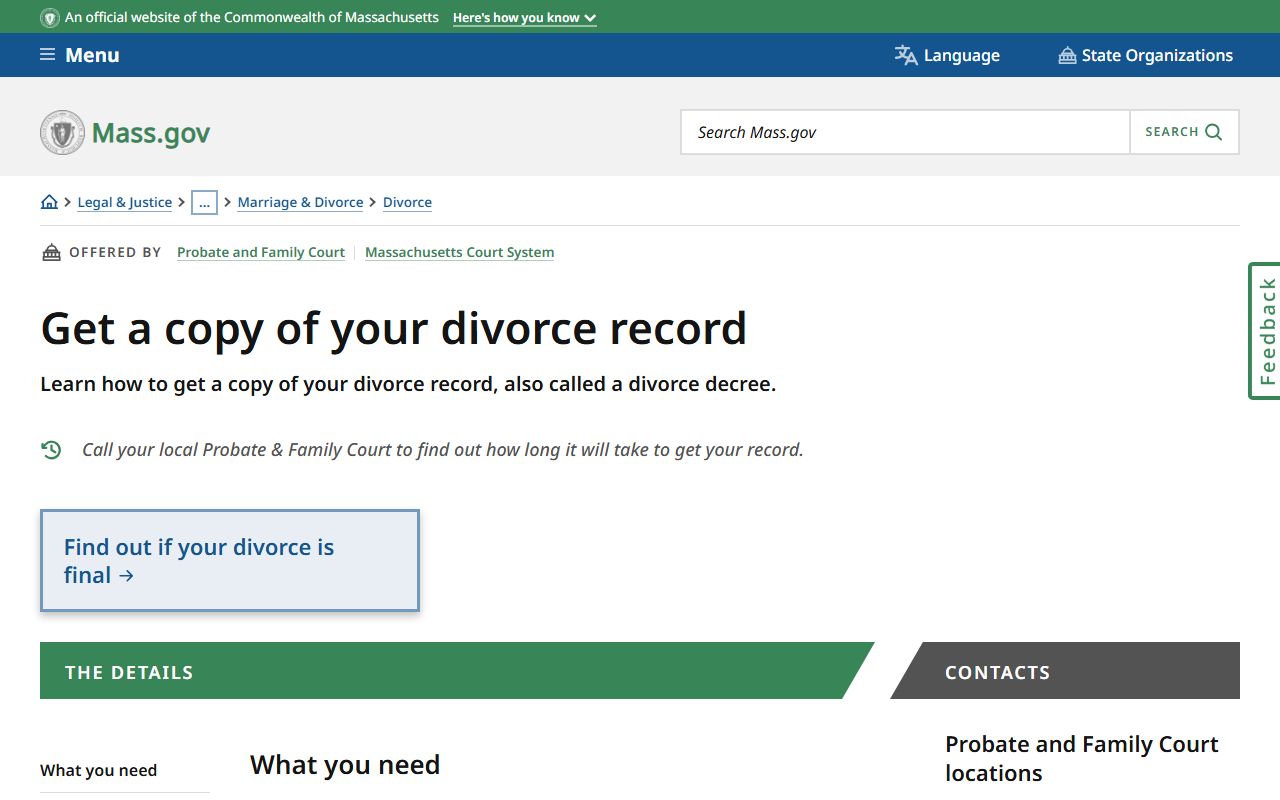
Use the official page on how to get a copy of your divorce record. A certified copy may involve a search fee, and the register handles the request.
A divorce record holds more than the final decree. The fields below show what a Plymouth County divorce file can include.
| Field | What It Shows |
|---|---|
| Docket number | The case number for any copy request. |
| Parties | The petitioner and respondent, or joint petitioners. |
| Complaint or petition | How the case started. |
| Judgment of divorce nisi | The order that becomes final after a set period. |
| Restricted items | Financial statements and child materials, often impounded. |
Note: A judgment of divorce nisi is not final right away; it becomes absolute after the waiting period set by the court.
Fees for Marriage and Divorce Records
Fees depend on the office and the copy type. Marriage license and certificate fees are set locally or by the state registry. Divorce copy fees are set by the Probate and Family Court. Confirm the current amount with the office before you pay, since fees change.
| Item | Amount |
|---|---|
| Marriage license | Set by the city or town clerk |
| Certified marriage certificate | Set by the town or state registry |
| Divorce record copy | Set by Probate and Family Court; may include a search fee |
| Fee waiver | Available by affidavit of indigency for court filings |
Restricted Family Records
Family files carry sensitive material. Financial statements, child information, abuse-related materials, and adoption records may be impounded or sealed. Adoption records have their own confidentiality rules. To view a restricted family record, you usually need party status, counsel, or a court order. For the office that keeps these files, see the Register of Probate page, and for the public records framework see public records.
Older marriage records and historic genealogical entries may live with the town clerk or the state archives rather than the current registry. If a search returns nothing through the modern channels, ask the town clerk where the record was filed. Many towns keep bound vital-records books that go back well beyond what the online system covers.